


Power New kind of transistor could shrink communications devices on smartphones 1
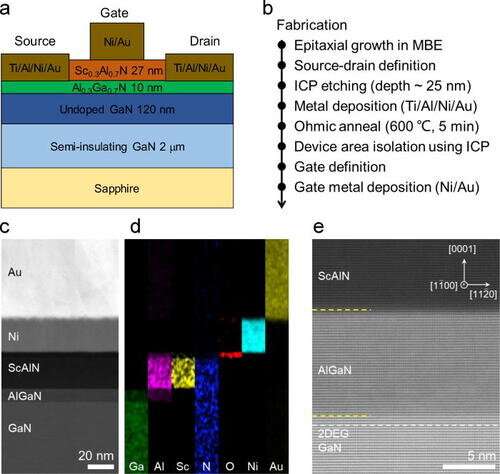
The study is a featured article in Applied Physics Letters.
“By realizing this new type of transistor, it opens up the possibility for integrating multifunctional devices, such as reconfigurable transistors, filters and resonators, on the same platform—all while operating at very high frequency and high power,” said Zetian Mi, U-M professor of electrical and computer engineering who led the research, “That’s a game changer for many applications.”
At its most basic level, a transistor is a kind of switch, letting an electric current through or preventing it from passing. The one demonstrated at Michigan is known as a ferroelectric high electron mobility transistor (FeHEMT)—a twist on the HEMTs that can increase the signal, known as gain, as well as offering high switching speed and low noise. This makes them well suited as amplifiers for sending out signals to cell towers and Wi-Fi routers at high speeds.
Ferroelectric semiconductors stand out from others because they can sustain an electrical polarization, like the electric version of magnetism. But unlike a fridge magnet, they can switch which end is positive and which is negative. In the context of a transistor, this capability adds flexibility—the transistor can change how it behaves.
“We can make our ferroelectric HEMT reconfigurable,” said Ding Wang, a research scientist in electrical and computer engineering and first author of the study. “That means it can function as several devices, such as one amplifier working as several amplifiers that we can dynamically control. This allows us to reduce the circuit area and lower the cost as well as the energy consumption.”