


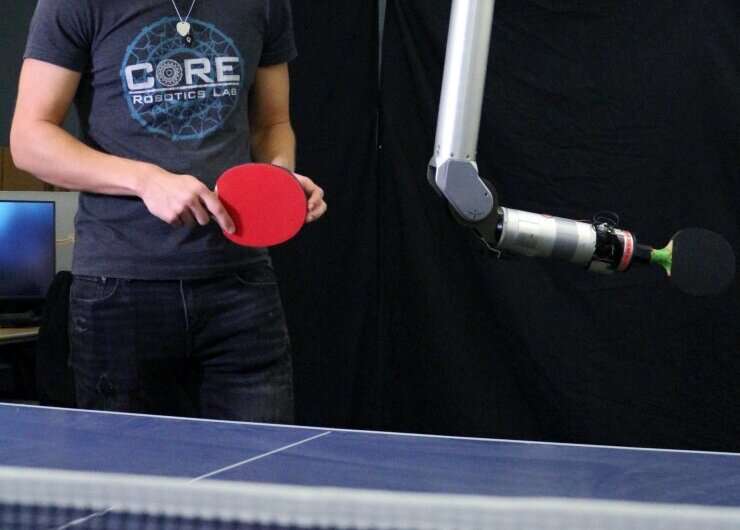
A team of researchers, led by Matthew Gombolay, an assistant professor in the School of Interactive Computing and director of the Cognitive Optimization and Relational (CORE) Robotics Lab at Georgia Tech, are using the sport of table tennis to showcase that humans may not always trust a robot’s explanation of

A team of researchers, led by Matthew Gombolay, an assistant professor in the School of Interactive Computing and director of the Cognitive Optimization and Relational (CORE) Robotics Lab at Georgia Tech, are using the sport of table tennis to showcase that humans may not always trust a robot’s explanation of
A team of researchers, led by Matthew Gombolay, an assistant professor in the School of Interactive Computing and director of the Cognitive Optimization and Relational (CORE) Robotics Lab at Georgia Tech, are using the sport of table tennis to showcase that humans may not always trust a robot’s explanation of
A team of researchers, led by Matthew Gombolay, an assistant professor in the School of Interactive Computing and director of the Cognitive Optimization and Relational (CORE) Robotics Lab at Georgia Tech, are using the sport of table tennis to showcase that humans may not always trust a robot’s explanation of
A team of researchers, led by Matthew Gombolay, an assistant professor in the School of Interactive Computing and director of the Cognitive Optimization and Relational (CORE) Robotics Lab at Georgia Tech, are using the sport of table tennis to showcase that humans may not always trust a robot’s explanation of
A team of researchers, led by Matthew Gombolay, an assistant professor in the School of Interactive Computing and director of the Cognitive Optimization and Relational (CORE) Robotics Lab at Georgia Tech, are using the sport of table tennis to showcase that humans may not always trust a robot’s explanation of
A team of researchers, led by Matthew Gombolay, an assistant professor in the School of Interactive Computing and director of the Cognitive Optimization and Relational (CORE) Robotics Lab at Georgia Tech, are using the sport of table tennis to showcase that humans may not always trust a robot’s explanation of
A team of researchers, led by Matthew Gombolay, an assistant professor in the School of Interactive Computing and director of the Cognitive Optimization and Relational (CORE) Robotics Lab at Georgia Tech, are using the sport of table tennis to showcase that humans may not always trust a robot’s explanation of
A team of researchers, led by Matthew Gombolay, an assistant professor in the School of Interactive Computing and director of the Cognitive Optimization and Relational (CORE) Robotics Lab at Georgia Tech, are using the sport of table tennis to showcase that humans may not always trust a robot’s explanation of