


A faster way to preserve privacy online
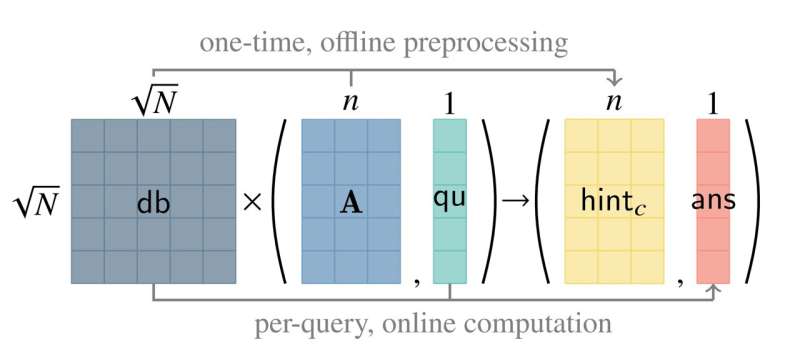
Searching the internet can reveal information a user would rather keep private. For instance, when someone looks up medical symptoms online, they could reveal their health conditions to Google, an online medical database like WebMD, and perhaps hundreds of these companies’ advertisers and business partners.
For decades, researchers have been crafting techniques that enable users to search for and retrieve information from a database privately, but these methods remain too slow to be effectively used in practice.
MIT researchers have now developed a scheme for private information retrieval that is about 30 times faster than other comparable methods. Their technique enables a user to search an online database without revealing their query to the server. Moreover, it is driven by a simple algorithm that would be easier to implement than the more complicated approaches from previous work.
Their technique could enable private communication by preventing a messaging app from knowing what users are saying or who they are talking to. It could also be used to fetch relevant online ads without advertising servers learning a users’ interests.
“This work is really about giving users back some control over their own data. In the long run, we’d like browsing the web to be as private as browsing a library. This work doesn’t achieve that yet, but it starts building the tools to let us do this sort of thing quickly and efficiently in practice,” says Alexandra Henzinger, a computer science graduate student and lead author of a paper introducing the technique.