


Researchers develop a novel thermoelectric generator inspired by zebra skin 1
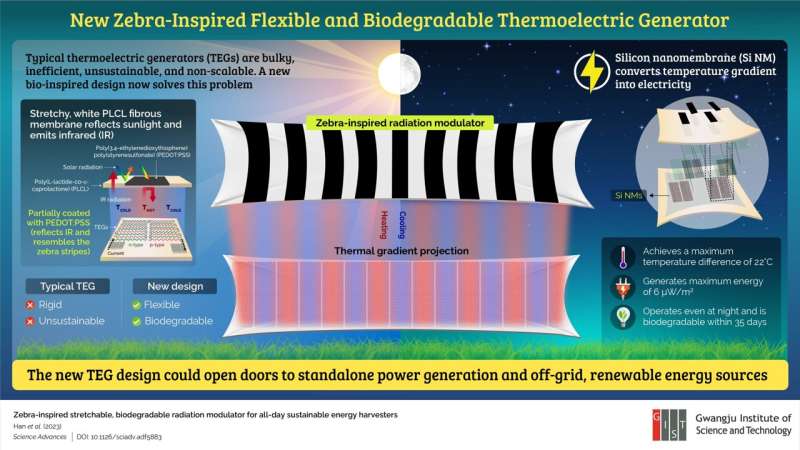
Thermoelectric generators (TEG) are devices that can convert temperature gradients to electricity. Such devices are extremely useful for generating electricity for remote sensors that cannot be connected to the main electricity grid. A conventional TEG is composed of one side (top or bottom) that radiates heat to cool down and the other side that absorbs heat from the sun or the environment.
This, in turn, generates an out-of-plane temperature gradient, which is converted into electricity. However, such requirements often make for designs that are bulky, complex, and inefficient. This, in turn, makes TEGs hard to integrate with other components or systems, limiting their applications in renewable energy systems.
Fortunately, researchers from Korea may now have found a way to surmount these challenges. In a new study, the researchers, led by Professor Young Min Song from Gwangju Institute of Science and Technology (GIST), reported a new flexible, lightweight, and biodegradable TEG that gets its inspiration from an unlikely place—zebra skin. Essentially, the design uses a pattern resembling black-and-white zebra stripes to create a high in-plane temperature gradient for generating electricity. The breakthrough was published in Science Advances.
“Traditional TEG designs are large and bulky as they rely on natural convection, which leads to an out-of-plane temperature gradient. This requires hard insulators, which limit the application of TEGs in flexible and wearable devices. We have now transcended this paradigm in our design by creating an in-plane device that is flexible and biodegradable. This increases its applicability while reducing its environmental impact by making it scalable, integrable, and sustainable,” explains Prof. Song.