


Find –Tuning thermoelectric materials for efficient power generation …
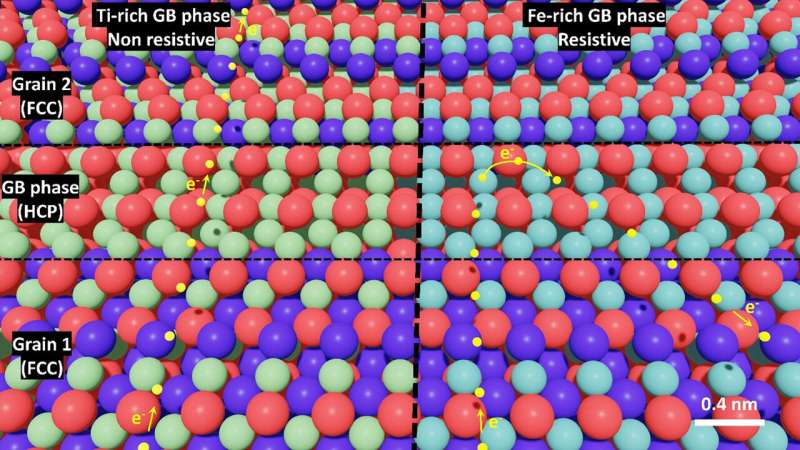
In times when energy is scarce and sustainable ways of energy production are being explored, thermoelectric materials are being considered for power generation to transform waste heat into electricity. However, to make this transformation more efficient, and thus usable on an industrial scale, a better understanding of the functional and structural properties of the materials is needed.
A researcher team led by the Max-Planck-Institut für Eisenforschung (MPIE) has now been able to tune the microstructure of a promising new thermoelectric material for efficient energy conversion. The team published their results in the journal Advanced Energy Materials.
Tuning thermoelectric properties through grain boundary engineering
Previous research has shown that the structure and composition of grain boundaries are crucial for the thermal and electrical conductivity of thermoelectric materials. Usually, grain boundaries reduce both the thermal and electrical conductivity of the material while it is desirable to have a low thermal, but a high electrical conductivity.
The aim of the researchers from MPIE, the Northwestern University (U.S.) and the Leibniz Institute for Solid State and Materials Research Dresden (Germany) was to modify the grain boundaries so that only thermal conductivity is reduced, while their electrical conductivity remains high. They used a Ti-doped NbFeSb half-Heusler intermetallic compound—a recently developed, but promising thermoelectric alloy.