


Find –3D battery imaging reveals the secret real-time life of lithium metal cells it !
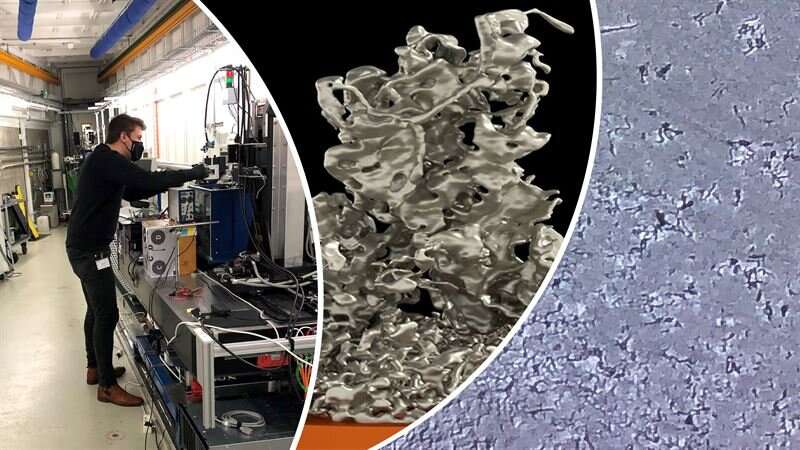
Innovative battery researchers have cracked the code to creating real-time 3D images of the promising but temperamental lithium metal battery as it cycles. A team from Chalmers University of Technology, Sweden, have succeeded in observing how the lithium metal in the cell behaves as it charges and discharges.
The new method may contribute to batteries with higher capacity and increased safety in our future cars and devices.
“We’ve opened a new window in order to understand—and in the long term to optimize—the lithium metal batteries of the future. When we can study exactly what happens to the lithium in a cell during cycling, we gain important knowledge of what affects its inner workings,” says Aleksandar Matic, professor at the Department of Physics at Chalmers and head of the scientific study that was recently published in Nature Communications.
There are high hopes that new battery concepts, such as lithium metal batteries, will be able to replace today’s lithium-ion batteries. The goal is to develop more energy-dense and safer batteries that will take us further at a lower cost—both financially and environmentally. Solid-state batteries, lithium-sulfur batteries and lithium-oxygen batteries are among those being held up as promising alternatives. All of these concepts build on the idea that the battery anode, consists of a lithium metal instead of the graphite that is in today’s batteries. Without graphite, the battery cell will be lighter, and with lithium metal as the anode it will also be possible to use high-capacity cathode materials. This makes it possible to achieve three to five times the energy density.